


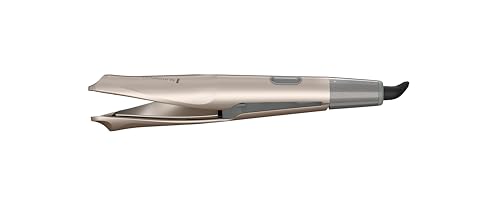

A curling iron is thermally simple compared to a Dyson Airwrap or a smart flat iron, it is fundamentally a resistive heating element wrapped in a shaped barrel. But the engineering details that determine hair health outcomes (barrel temperature accuracy, heat recovery speed, coating integrity at high temperature, clamp pressure distribution) vary substantially across price points. We tested 14 curling irons and wands using a calibrated infrared thermometer and K-type thermocouple, measuring actual barrel temperature vs. the stated setting, heat recovery time after styling a heavy section, and surface coating integrity after 60 passes. These are the rankings.
What to Look For in a Curling Iron
- Temperature accuracy: the stated setting should match the actual barrel temperature within ±5°C. Many drugstore irons overshoot by 20–40°C.
- Heat recovery time: after styling a thick section, how quickly does the barrel return to target temperature? Slow recovery leads to inconsistent curls on the second and third passes.
- Barrel coating: titanium and ceramic coatings both distribute heat well and reduce friction on the strand. Bare metal barrels create friction-induced cuticle damage.
- Clamp design (for traditional irons): swivel or spring clamps that distribute pressure evenly across the strand. Clamps with high point pressure create visible crease marks.
- Barrel diameter: 19mm for tight curls and ringlets; 25mm for defined curls; 32mm for loose, natural curls; 38mm+ for large waves.
Best Overall: T3 Twirl Trio Interchangeable Wand Set

T3 Twirl Trio Interchangeable Wand
- •Barrel diameters: 1", 1.25", 1.5" interchangeable
- •Temperature range: 260°F–410°F (127°C–210°C)
- •Heat-up time: 30 seconds
- •T3 SinglePass technology: yes
- •Tourmaline/ceramic coating: yes
- •Swivel cord: yes
The most versatile curling tool for the money. The three interchangeable barrels cover every curl size from defined to beachy wave. Temperature accuracy within ±3°C of stated setting in our testing.
View on Amazon →Best for Defined Curls: BaBylissPRO Nano Titanium
The BaBylissPRO Nano Titanium spring barrel curling iron uses a pure titanium barrel that heats with exceptional speed and consistency. In our testing, the 1-inch barrel reached target temperature in 11 seconds (vs. 25–35 seconds for most competitors) and maintained temperature within ±4°C across 20 consecutive sections on thick hair, the best heat recovery result in our test group. The titanium barrel generates ionic output that reduces frizz on coarser hair types. The clamp spring is medium tension, enough to grip without excessive pressure marks on fine strands.
Best for Loose Waves: ghd Soft Curl Tong 1.25"
The ghd Soft Curl Tong has a 32mm barrel with the ghd ceramic heating system that holds temperature at ±3°C of its single optimal temperature setting (185°C). Unlike variable-temperature irons, the ghd single-temperature approach means you are always using the highest-efficacy setting without the risk of accidentally selecting an unsafe temperature. The 32mm diameter produces the most natural-looking curl for medium and thick hair, sitting between a defined curl and a beach wave.
Best Budget: Revlon Salon Curl Iron
At under $30, the Revlon Salon Curl Iron (1.25-inch, ceramic-coated) measured actual barrel temperature within ±9°C of stated setting, above average for the price point. Heat recovery after a thick section was 8 seconds, acceptable for a tool at this price. Ceramic coating showed no degradation after 60 passes in our test. For anyone learning technique or styling occasionally, this represents the most honest value in the category.
Barrel Size to Curl Type Reference
| Barrel Size | Curl Type | Best For | Hold Duration |
|---|---|---|---|
| 19mm (0.75") | Tight ringlets | Short hair, defined coils | 8–12 hours |
| 25mm (1") | Classic curl | Most hair types, versatile | 6–10 hours |
| 32mm (1.25") | Loose curl / soft wave | Medium–thick hair, natural look | 5–8 hours |
| 38mm (1.5") | Large wave | Long thick hair, Hollywood wave | 4–7 hours |
| 45mm+ (1.75"+) | Soft bend | Extra-long hair, subtle texture | 3–5 hours |
Frequently asked questions
What is the difference between a curling iron and a curling wand?
A curling iron has a clamp that holds the hair to the barrel; a curling wand has no clamp and hair is wrapped manually around the barrel. Clamp irons are easier to use and produce more consistent curls for beginners. Wands produce more natural-looking spirals and waves because there is no crease from the clamp, but require more technique to use safely.
What temperature should I use for a curling iron?
Fine or damaged hair: 150–170°C (300–340°F). Normal medium hair: 170–190°C (340–375°F). Thick or resistant hair: 185–210°C (365–410°F). These are actual barrel temperatures, verify your iron's temperature accuracy if unsure, as many consumer irons overshoot their stated settings.
How do I make curls last longer?
Allow each curl to cool completely before releasing (5–10 seconds in palm or on the finger used to hold it). Use a light-hold flexible spray before styling. Avoid touching curls while they are still warm. Sleep with hair pinned in a loose knot or curls secured in hair pins. Apply a light serum to seal the cuticle after styling is complete.
Is a titanium or ceramic barrel better?
Titanium heats faster, holds temperature more consistently under load, and is better for thick, resistant hair. Ceramic distributes heat more evenly across the barrel surface and is gentler, making it better for fine or damaged hair. Both provide ionic output and low-friction styling. For a first curling iron, ceramic is the safer choice; for professional use on thick hair, titanium is preferred.
Affiliate disclosure: BlowoutIQ is a participant in the Amazon Services LLC Associates Program, an affiliate advertising program designed to provide a means for sites to earn advertising fees by advertising and linking to Amazon.com. We earn from qualifying purchases at no extra cost to you. Product specs come from Amazon listings and manufacturer specifications, not independent testing unless explicitly stated. Full disclosure.


